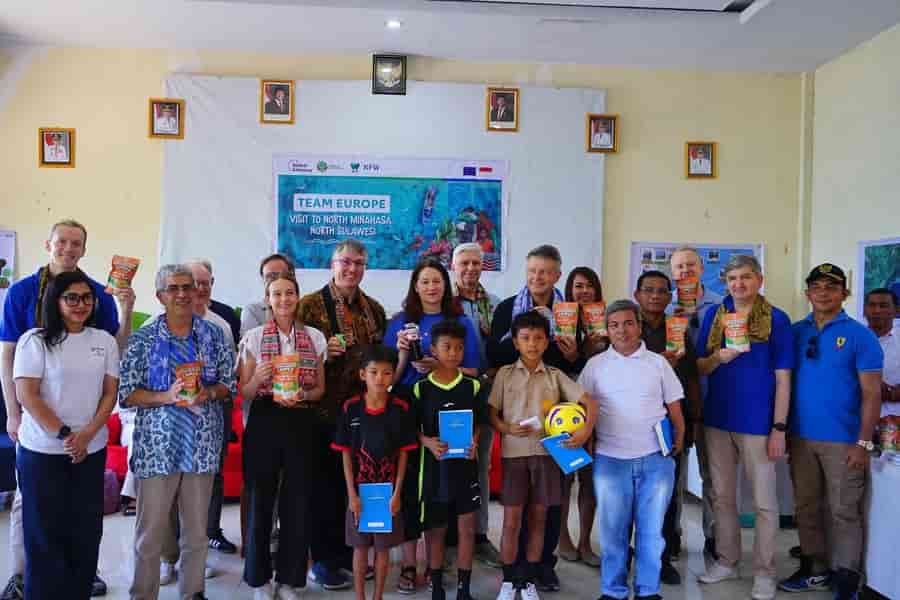
trenddjakarta.com, North Minahasa, North Sulawesi, 18 July 2026 – A European delegation comprising ambassadors and senior representatives from the embassies of Austria, Belgium, Bulgaria, Czech Republic, Denmark, Finland, France, Ireland, Lithuania, the Netherlands, Portugal, Spain, and the Delegation of the European Union to Indonesia visited North Minahasa today to visit the Marine Biodiversity and Support of Coastal Fisheries in the Coral Triangle programme.
Implemented in partnership with Indonesia’s Ministry of Forestry through the Directorate General of Natural Resources and Ecosystem Conservation (KSDAE). The programme operates across North Sulawesi, and North Maluku. It is funded by the European Union through the German Development Bank (KfW) and implemented in collaboration with. The Wildlife Conservation Society (WCS) Indonesia Programme building on a separate, complementary programme financed by the German Federal Ministry for the Environment. Climate Action, Nature Conservation and Nuclear Safety (BMUKN). That includes North Sulawesi, Aceh and West Nusa Tenggara. This reflects collective action between the European Union. And its member state to contribute to Indonesia’s marine conservation and sustainable blue economy.
Located at the heart of the Coral Triangle the world’s richest marine biodiversity hotspot. Indonesia is home to some of the planet’s most valuable coral reef ecosystems. North Minahasa has been identified as one of the programme’s priority landscapes. With its coral reefs, seagrass meadows and mangrove forests. In addition to serving as a buffer zone for the Bunaken National Park in preserving marine ecosystems. This region also supporting food security and the livelihoods of thousands of coastal residents.
During the visit. the European delegation joined representatives of the Government of Indonesia in touring marine protected areas and meeting community groups. That from the villages of Gangga Dua, Bahoi, Lihunu, Tarabitan, Bulutui and Galo-Galo. The visit provided an opportunity to witness first-hand how collaboration between government institutions, international partners and local communities. That is restoring marine ecosystems while generating sustainable economic opportunities for coastal populations.
“Indonesia plays a vital role for the planet as home to some of the world’s richest marine ecosystems. Through the Global Gateway strategy. The European Union is supporting efforts to restore coral reefs, strengthen fisheries. And create opportunities for coastal communities, including in North Minahasa. Together, we are showing that protecting nature also supports jobs and sustainable growth,” said H.E Denis Chaibi, Ambassador of the European Union to Indonesia.
Since 2019, WCS Indonesia has managed two programmes financed by the European Union and the German BMUKN. That under the supervision of KfW Development Bank aimed at strengthening marine protected area management, sustainable fisheries governance and coastal livelihoods in North Sulawesi, North Maluku, West Nusa Tenggara and Aceh. The initiative has expanded efforts to safeguard critical marine ecosystems and coastal fisheries across Indonesia, the Philippines and the wider Coral Triangle.
Representing Director General of Directorate General of Natural Resources and Ecosystem Conservation (KSDAE), Secretary of the Directorate General of KSDAE, Nandang Prihadi, stated.
“We value the joint efforts of North Minahasa Regency Government, the European Union, KfW German Development Bank, WCS, and all partners who have contributed to the organisation of this event. We hope this field visit will serve as a momentum to strengthen international cooperation while showcasing best practices in conservation area management and community empowerment in North Sulawesi.”
Delivering Measurable Results
The programme has generated significant environmental, economic and social benefits across North Sulawesi, North Maluku, West Nusa Tenggara and Aceh. In marine conservation, it has supported the establishment and improved management of 21 Marine Protected Areas. That covering more than 1,631,572 hectares in those four regions. Safeguarding 16,613 hectares of coral reefs, 14,186 hectares of mangrove forests, and 510,582 hectares of seagrass beds with the support of the European Union.
To strengthen sustainable fisheries and food security, the programme has established four ecosystem-based fisheries management areas. Helping maintain healthy populations of 27 commercially important fish species. Including snapper, grouper and small pelagic fish that underpin local livelihoods. In Gangga Dua Village, a community-agreed seasonal closure of lift-net fisheries, has more than doubled fishers’ seasonal incom. From approximately IDR 20 million to IDR 48 million.
The programme has also expanded conservation-based livelihoods. Twenty-nine Community Surveillance Groups (Pokmaswas) and 19 coastal community organisations are now engaged in sustainable enterprises. Including seafood processing and value-added products. In Bulutui Village, the Kalkop Fish Processing Group (Poklahsar) has increased women’s incomes through the production of fish balls and banana crisps.
Community-based ecotourism has likewise flourished. Tourism Awareness Groups (Pokdarwis) in Bahoi and Lihunu have developed snorkelling tours, homestays and local guiding services. While Lihunu was recognised among Indonesia’s Top 500 Tourism Villages by the Ministry of Tourism in 2024.
The programme has also strengthened long-term governance and financing. The Provincial Government has committed to developing a performance-based public service financing mechanism (BLUD). To support the sustainable management of marine protected areas and fisheries, reducing reliance on short-term donor funding.
Overall, the programme has directly benefited 5,752 people. And indirectly reached more than 24,500 beneficiaries through capacity building, strengthened community institutions and the development of sustainable livelihoods.
Mayor General TNI (Purn) Yulius Selvanus, SE, Governor of North Sulawesi, expressed his appreciation and warm welcome to the European Union Delegation.