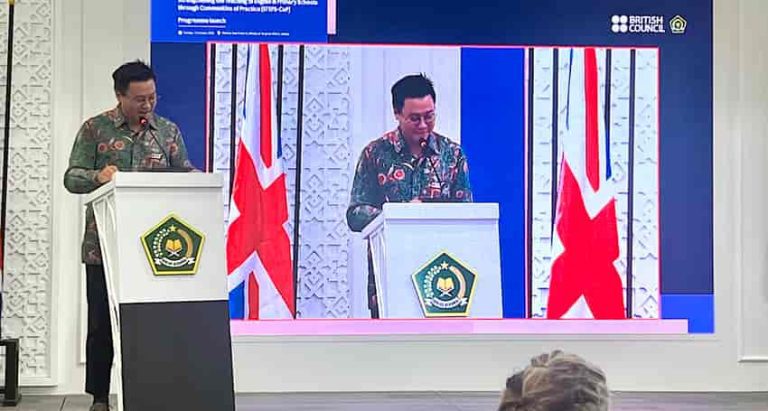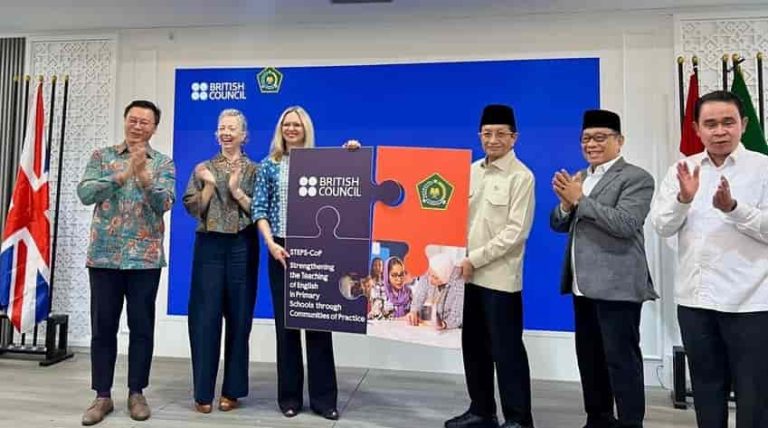
trenddjakarta.com, Jakarta, 13 October 2026 – Ahead of the introduction of English as a compulsory subject for students in Grades 3–6 at Madrasah Ibtidaiyah (MI) from July 2027, the British Council, together with the Directorate of Madrasah Teachers and Education Personnel, Ministry of Religious Affairs of the Republic of Indonesia, has launched the Strengthening the Teaching of English in Primary Schools through Communities of Practice (STEPS-CoP) programme.
The programme will involve 6,000 English and MI teachers across 34 cities and regencies, supported by 68 Community of Practice (CoP) Leaders. More than simply reaching a target number of participants. STEPS-CoP is designed to ensure that teachers have the space, support. And also opportunities they need to continue developing professionally as Indonesia prepares for the implementation of the new policy.
Summer Xia, Country Director Indonesia and Director ASEAN, British Council. That the collaboration with the Directorate of Madrasah Teachers and Education Personnel represents an important opportunity. That to support the Indonesian Government’s efforts to strengthen English language education from the primary level.
“Preparing for compulsory English in madrasahs is about more than a curriculum change. It is about equipping teachers to open up new opportunities for millions of children across Indonesia. Through STEPS-CoP, we are combining the British Council’s global expertise with the knowledge and experience of Indonesian educators. To build a model of professional development that can grow and endure. By empowering teachers to learn from one another and lead change in their own communities. We want to ensure that high-quality English education reaches more children, wherever they live and whatever their background.” Said Summer Xia.
English language proficiency is increasingly important not only as an academic skill. But also as a gateway to knowledge, technology, networks and global opportunities. For MI students, learning English from an early age can provide a foundation that helps them grow with greater confidence and participate in an increasingly connected world.
Preparing for the 2027 policy therefore requires more than simply adding English to the curriculum. The quality of students’ learning experiences will ultimately depend on the readiness of the teachers standing in front of the classroom.
More Than Training That Ends in the Classroom
A defining feature of STEPS-CoP is its community-based approach to professional development. Rather than treating training as an activity that ends when a session is over, the programme encourages teachers to continue learning together, discussing challenges they encounter in the classroom, exchanging experiences and developing good practice with their peers.
A total of 68 CoP Leaders will be prepared through a Training of Trainers programme to serve as facilitators and drivers of teacher learning communities across 34 cities and regencies. They will support the development of 6,000 teachers while helping to ensure that professional learning continues through these communities. The British Council’s EnglishScore and a Self-Assessment Tool (SAT) will also be used to help map teachers’ English language proficiency and pedagogical competencies. By understanding each teacher’s starting point and areas for development, professional learning can be made more targeted and responsive, rather than relying on a one-size-fits-all approach.
“Teachers do not need yet another training programme that ends when the session is over. We need space to continue learning once we return to the classroom. To discuss the challenges we face, share practices that work, and learn from the experiences of fellow teachers.” Said Septriani Nidi, School Supervisor at the Bandar Lampung City Office of Basic and Secondary Education, UK Alumni, and one of the facilitators of Training of Trainer for CoP Leaders.
According to Septriani, her previous experience of professional development has shown that learning becomes far more meaningful when teachers feel part of a learning community.
“That is what we want to build through STEPS-CoP: a space where teachers do not have to learn in isolation, and where every improvement in our competence can ultimately translate into tangible benefits for our students,” she added.
Expanding Possibilities for Madrasah Students
According to the latest official data for the first semester of 2025, there are 26,826 Madrasah Ibtidaiyah across Indonesia. Given this scale, STEPS-CoP is not positioned as the single solution to all teacher development needs. But as an initial step towards building a professional development model that can continue to grow. And be replicated and gradually expanded. The 6,000 teachers involved in the programme therefore represent a starting point for impact that can extend more widely over time.
Education is also an important foundation of the long-term relationship between the United Kingdom and Indonesia. Through STEPS-CoP, this collaboration aims to strengthen the quality of English language teaching in madrasahs. So that more students are better equipped to access knowledge and wider opportunities. This approach places teachers at the heart of change. When a teacher is given the opportunity to strengthen their capabilities, the benefits do not stop with that individual. The knowledge, skills and teaching practices they develop are carried back into the classroom. And can continue to benefit many students throughout their career. By strengthening one teacher, we do more than improve one classroom. That we expand the possibilities for every child who will learn from them.
Minister of Religious Affairs of the Republic of Indonesia Prof. Dr. KH. Nasaruddin Umar, MA emphasised that the introduction of English at Madrasah Ibtidaiyah should be seen within the broader vision for madrasah education.
“Introducing English at Madrasah Ibtidaiyah is not simply about adding another subject. It is part of our effort to prepare madrasah students with the ability to access knowledge. And engage with an increasingly open world, while remaining firmly rooted in their values and character,” he said.
According to the Minister, teacher readiness is inseparable from the success of this transition.
“Teachers must be given opportunities to continue learning, strengthen their competencies and support one another. We hope this collaboration can foster a culture of sustained professional development. So that the policy change in 2027 genuinely translates into better learning experiences for madrasah students across Indonesia,” he added.
Supporting Teachers, Investing in Students
The successful introduction of English as a compulsory subject will ultimately require support that extends beyond government, the British Council and the teachers participating in the programme. Madrasah leaders need to provide teachers with the time and space to continue learning. Parents and communities also have an important role to play in encouraging positive attitudes towards learning English from an early age. Without turning it into an additional source of academic pressure for children.
“Training can start change, but empowered teachers and strong professional communities sustain it. STEPS-CoP is designed to make professional learning part of everyday teaching. So its impact reaches far beyond the 6,000 teachers directly involved. Ultimately, this is about more than teaching English. It is about giving children the skills, confidence and opportunities to shape their own futures. When we invest in teachers, we multiply the opportunities we create for every generation of learners,” concluded Summer Xia.
(***)